
APEX Production Lines
Cocoa Liquor Production Line
From cocoa beans to cocoa liquor, this processing line brings together raw material preparation, roasting, grinding, and finishing. Cleaning and shell separation prepare the cocoa material for further processing, while staged grinding produces cocoa liquor for use in chocolate manufacturing or cocoa butter and powder production. The process configuration is selected to match the raw material, product requirements, and downstream application.
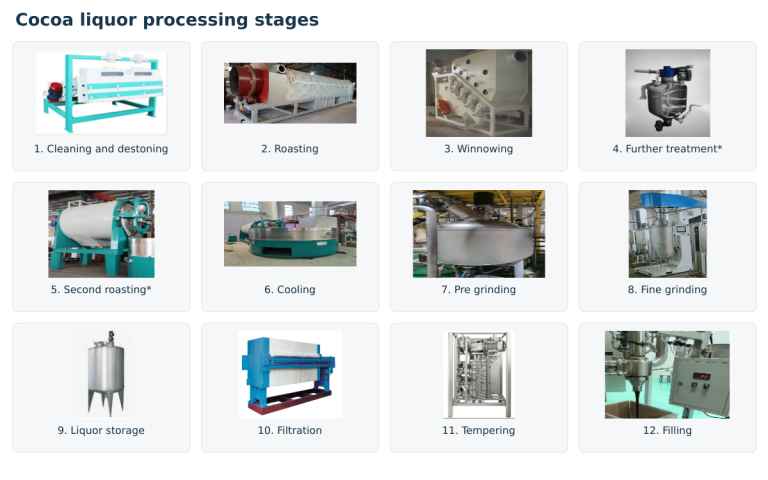
Production process: Cleaning and destoning → Roasting → Winnowing → Further treatment* → Second roasting* → Cooling → Pre grinding → Fine grinding → Liquor storage → Filtration → Tempering → Filling.
*Further treatment and second roasting follow the project-specific process route. Their inclusion and operating conditions depend on the selected recipe and equipment configuration.
Discuss your cocoa liquor project
Tell us your cocoa bean type, required throughput, target liquor fineness, and preferred delivery format. Contact APEX to discuss the process configuration and plant layout.
How Cocoa Liquor Is Produced
Cleaning and destoning
The cleaning section removes extraneous material from incoming cocoa beans. Destoning separates stones and other dense impurities, helping protect downstream equipment and support a more consistent feed.
Roasting and winnowing
Roasting develops characteristic cocoa aromas and changes the moisture condition of the beans. The source process shows natural gas roasting or hot-air roasting as alternative equipment routes. Winnowing separates loosened shell material from the cocoa nibs before the next processing stage.
Further treatment and cooling
The illustrated route includes an additional treatment stage and a second roasting stage. Their use is determined by the product recipe and confirmed process design. Cooling brings the treated material to a suitable condition for downstream grinding.
Pre-grinding and fine grinding
Pre-grinding reduces cocoa nibs to a coarse mass. Fine grinding further reduces particle size and produces cocoa liquor containing cocoa solids dispersed in cocoa butter. The target fineness is selected according to its use in chocolate making or subsequent pressing.
Liquor storage and filtration
The storage tank provides a buffer between grinding and finishing. Filtration removes retained coarse material according to the filter specification. This filtration step is separate from the pressing operation used to extract cocoa butter.
Tempering and filling
The illustrated finishing section includes tempering followed by filling. Temperature conditioning and filling arrangements are selected for the required cocoa liquor product format. Any downstream cooling or packaging equipment should be defined as part of the final supply scope.
Value for the production line
Coordinating preparation, thermal processing, and grinding helps maintain consistent feed conditions throughout cocoa liquor production. Matching the finishing section to the intended application supports smoother transfer into chocolate processing or cocoa ingredient production.
Cocoa Butter and Powder Production Line
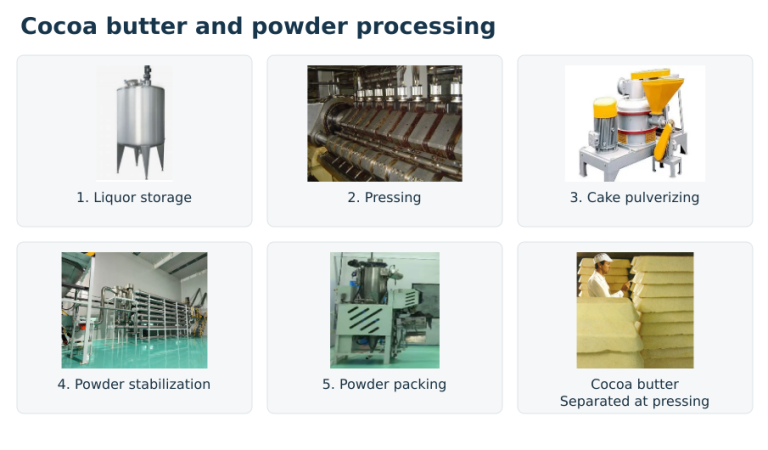
This line processes cocoa liquor into two valuable ingredients: cocoa butter and cocoa powder. Pressing separates cocoa butter from the solid cocoa cake, while the cake continues through pulverizing, powder stabilization and packing. The combination supports cocoa ingredient production for chocolate, bakery and other food applications.
Pressing and cake pulverizing
Cocoa liquor is supplied from the storage tank to the press. Pressing removes part of the cocoa butter and leaves cocoa cake, which is then pulverized into powder. Residual fat content and powder fineness are defined by the selected equipment and process conditions.
Powder stabilization and packing
The stabilization section conditions the powder and promotes crystallization of its residual cocoa butter. This helps reduce agglomeration during subsequent handling and storage. The powder is then transferred to the packing equipment; cocoa butter follows a separate handling route.
Discuss your cocoa ingredient project
Send us your required pressing capacity, target powder fat content, fineness, and pack size. APEX can discuss the equipment arrangement and the required scope for both product streams.
Five Roll Chocolate Refining Line
The five-roll chocolate refining line combines mixing, pre-refining, fine refining, transfer, and conching in a coordinated chocolate mass preparation system. It is designed to reduce solid particle size, prepare a uniform refined mass and develop the handling properties needed for downstream chocolate processing. The 1300S Five Roll Refiner and 1800S Five Roll Refiner form the core model options for this refining route.
Production process
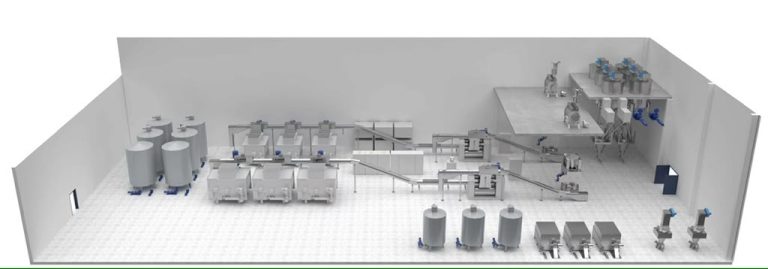
Ingredient mixing → Two roll pre refining → Five roll refining → Steel belt transfer → Conching.
More consistent preparation for downstream processing
Uniform mixing and pre refining help prepare the mass for the five roll refiner. Fine refining reduces the size of sugar, cocoa and milk solid particles to support a smoother mouthfeel. Steel belt transfer connects refining with conching, where further mixing, kneading and shearing help develop the chocolate mass. Coordinating these stages supports more consistent production conditions across the preparation section.
Connection to the finished chocolate line
After conching, the chocolate mass can be transferred to the appropriate storage and downstream processing equipment. Tempering, depositing or enrobing, cooling and packaging are selected according to the final product. These downstream stages are outside the five-stage refining process described here.
Plan your refining line
Tell us your chocolate recipe, required output, incoming particle size, and target fineness. Contact APEX to discuss model selection, equipment matching and the layout for your facility.
Machines in the Chocolate Refining Line
Chocolate Mixer
The mixer combines the recipe ingredients into a uniform mass before refining. It distributes the added fat through the solid ingredients. A consistent mixture helps maintain suitable feeding conditions at the next stage. The mixing process is adjusted to the formulation and required mass consistency. It prepares the material for two-roll pre-refining.
Two Roll Pre Refiner
The two-roll pre-refiner reduces coarse particles before fine refining. The mass passes through the working gap between the rolls. Pre-refining helps improve particle size consistency and mass plasticity. This provides a more uniform feed for the five roll refiner. Its operating conditions are matched to the recipe and downstream refining requirements.
1300S and 1800S Five Roll Refiners
The 1300S Five Roll Refiner and 1800S Five Roll Refiner reduce the size of solid particles in the chocolate mass. Successive roll passages apply compression and shear to refine the material. Controlling particle size helps reduce the perception of grittiness in the finished product. The refined mass is typically discharged as flakes for transfer to conching. Model selection depends on the required throughput, recipe, feed condition, and target fineness.
Steel Belt Conveyor
The steel belt conveyor transfers refined material to the next processing stage. It connects the discharge from the refining section with downstream handling. A coordinated transfer arrangement supports the movement of flake-like material through the line. Conveyor length, width, and discharge positions depend on the plant layout. Feed and discharge arrangements are matched to the connected equipment.
Chocolate Conche
The conche processes the refined mass through mixing, kneading and shearing under controlled temperature conditions. Appropriate process conditions help remove moisture and unwanted volatile compounds. Fat distribution and ingredient dispersion develop as conching progresses. Recipe additions and processing conditions are used to adjust the mass for downstream handling. Conching complements particle size reduction by developing flavor and flow properties.